
THE NEW MOON LETTERS
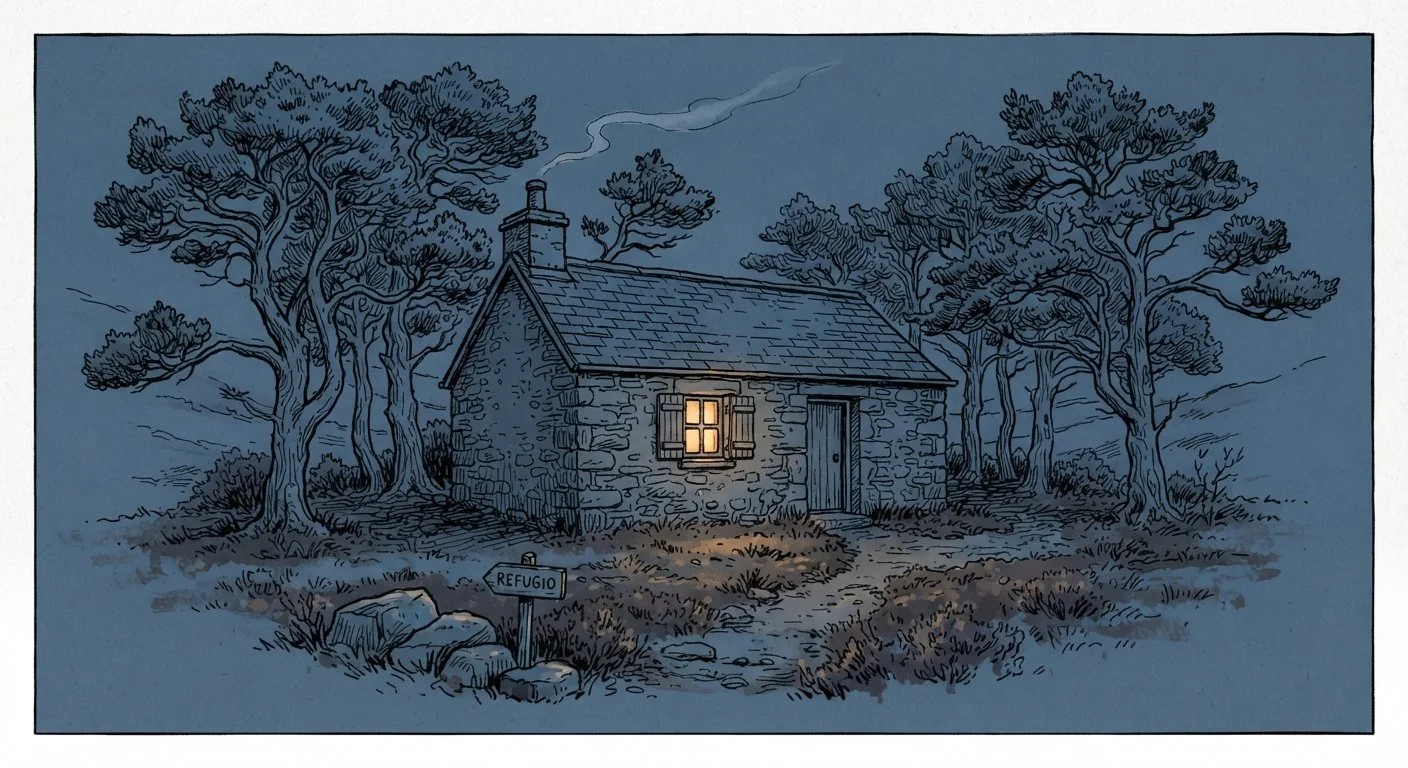
The new moon offers a natural pause. It represents total darkness—a quiet moment in the lunar cycle to clear the slate, step away from the digital stream, and reset our focus.
In his book about the Camino de Santiago, The Pilgrimage, Paulo Coelho captured the essence of the Refugio when describing the stark simplicity of the journey and the shared camaraderie under simple roofs. He emphasized how the path strips away modern pretense, leaving only what is essential.
But a Refugio is more than a place on the map. It is a collective space that exists wherever we choose to slow down and rest.
Collected here, the New Moon Letters arrive with each lunar cycle—a small collection of thoughts from the trail, field notes, tips, and reflections on living closely with the natural world.
There are no feeds to check here, and no rush to keep pace. Just an open door, a place to hang your coat and rest your boots.
NEW MOON LETTER
Stone and Salt: Finding Ground
September 11, 2026
This summer, I made three visits to the Isle of Iona—a rugged, sacred island on Scotland's western edge, spanning just five miles long and barely one mile wide. Perched on the rim of the grey-green Atlantic, Iona possesses a distinct physical spirit and weight.
Walking over the machair down to St. Columba Bay—a vast beach of large, time-worn pebbles—the immediate power of the landscape takes hold: soft white shell-sand, salt air, ancient Lewisian gneiss, and pale Iona marble underfoot, all forged billions of years ago among some of the oldest exposed stone on Earth. This is also the beginning of the pilgrimage of St. Columba's Way, stretching 240 miles across Scotland from Iona to St. Andrews, which I am walking in sections this year.
Out there, far beyond the pull of digital noise, the mind stops racing to keep pace with the stream. The friction of modern life gives way to simple flow. The rhythm of my boots matches the rhythm of my breath. Ambling across sand, mud, and grass, I arrive onto that same pebble beach where Saint Columba came ashore in the year 563. The sound of the wind and the swish of pebbles moved by soft water have endured perpetually—long before my bones began to grow.
In daily life, an enormous amount of human energy is spent floating above reality. The modern machine traps us in constant reaction—responding to notifications, managing feeds, and processing endless noise. Over time, we quietly accept the illusion that peace is something to be earned through relentless effort or higher achievement. I once acted as though I had to work continuously simply to justify my presence and maintain status.
Yet feeling the cool air on my face and listening to the rasping call of the corn crake, the wild exposes that pretence. Stepping into this stripped-back landscape, or slipping beneath routine deep within an old-growth forest, the environment systematically dismantles the clutter. It interrupts us. In that space, the fundamental truth emerges: instead of trying to reach somewhere else, we are already here. This groundedness is the most solid foundation. The clarity we seek is not a distant destination; it is our natural baseline once the clutter is removed. Resilience does not need to be manufactured. The raw landscape acts as a mirror, reflecting back the steady, unshakeable centre that was always present.
That practical clarity is precisely what we are offered in the forest, on the beach, in dawn's dew, and the soft brightness of sunset. On a long walk, life narrows down to what is immediate and real: physical distance covered under our own energy, the earth beneath our feet, the noticing of moments, and the quiet camaraderie of those walking beside us. The rain on my nose, the touch against my fingers of a pebble, the bark of a tree, of soft grass, and the scents of nature—these elements strip away pretence, leaving me with only what is vital.
With the arrival of this new moon, I close my eyes and imagine a wave washing the dust, sand, and seaweed from the slab of slate sitting in front of me on that beach.
As an invitation, take a few moments to contemplate the grounded energy of this new moon.
Perhaps you can step outside, feel your feet against the grass, press a hand against tree bark, stand on the cool step outside your door, or find a favourite spot indoors where you can look out at nature.
First, pause for three deep breaths. As you take the first breath, inhale calm. Exhale whatever you do not need. On the second breath, inhale patience. On the third breath, inhale deep relaxation.
If you are able, stand tall. Lean against a tree, a wall, your desk, or sit quietly in your car.
Now, if you have five minutes to spare, take a blank sheet of paper and a pen or pencil. You may even want to set a timer. The invitation is to write for five minutes, keeping your pen moving without stopping.
Write about a place held in your memory that now lives in your body. Record what you smell, taste, hear, see, and feel. To finish, write the name of a place you long to go, imagining when you might set out. Do one thing today which will advance you in the direction of that place.
Welcome this new moon phase—a fresh cycle to re-set your own course and return to what is simple and true.
Yours aye,
John Colver
. . .
If you would like to look at our upcoming training groups and guided tours, you can view the current logistics on the Monthly Updates page.
As we are stepping away from social media, future letters will be sent directly by email. If you would like to receive them, you can subscribe here